Figures are hypothetical and based on historical assumptions. They’re not guarantees and are for education only. A financial plan is an ongoing process that requires updates and judgment. Nothing here is individualized advice. If you’d like help pressure-testing your own plan, schedule a free intro call.
Background: Walter & Skylar
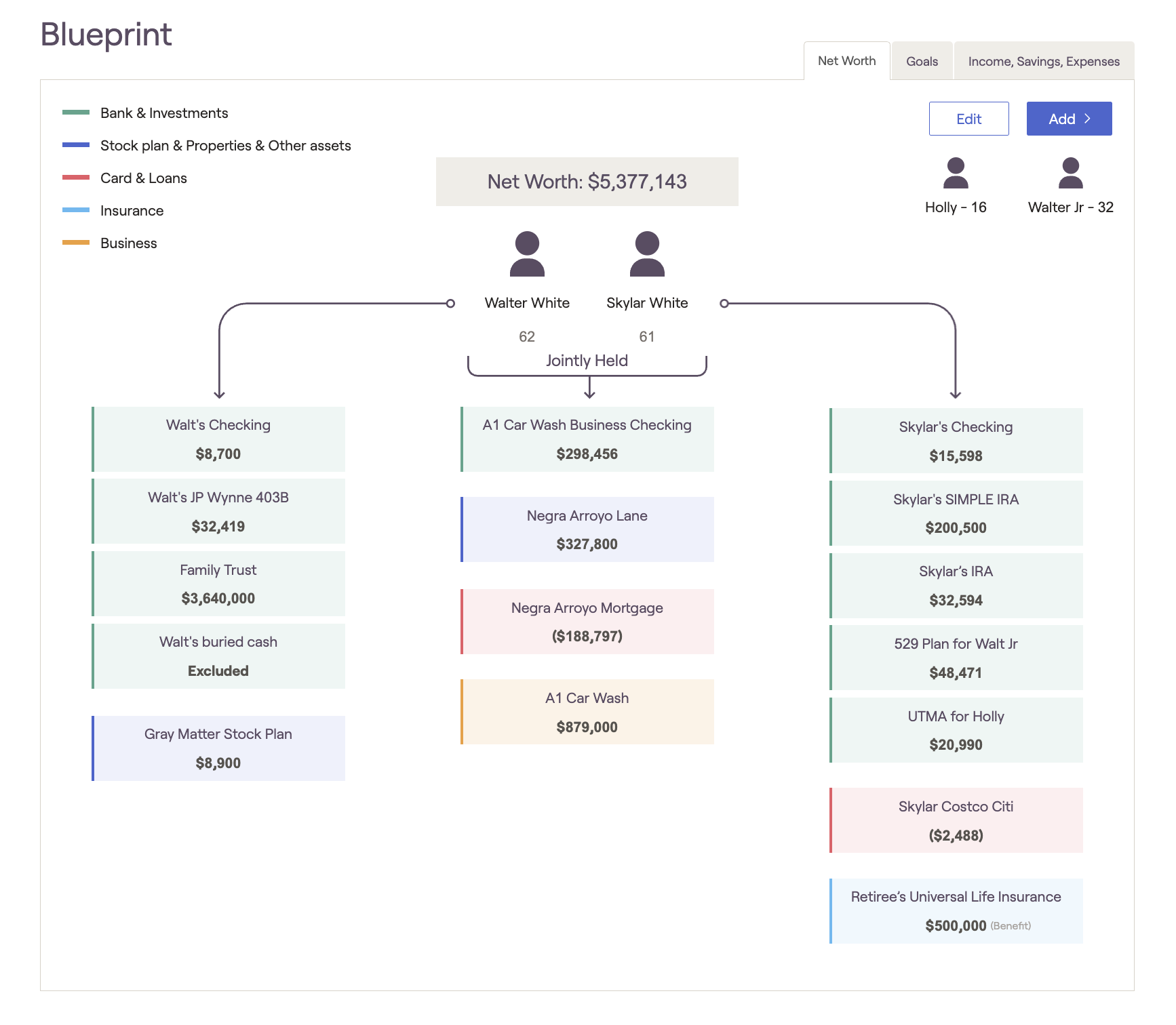
Walter and Skylar have two children, Walter Jr. and Holly. Walter, a highly educated former high-school chemistry teacher, shifted careers after a health scare and went on to run a successful pharmaceutical manufacturing and distribution venture before purchasing a car wash business. Skylar previously worked as a bookkeeper for Benecke Fabricators and now co-operates the car wash full-time.
They are within a few years of retirement and want clarity on:
When they can retire
What they can safely spend
When to claim Social Security
How to minimize taxes (including Roth conversions)
How to leave a meaningful legacy
After researching planners, they narrowed their criteria to fee-only, fiduciary, and credentialed (CFP®) with relevant retirement experience. They scheduled a 30-minute intro call with Daniel at Masuda Lehrman Wealth...
Initial Consultation
In the intro meeting, Daniel asked focused questions to understand:
What led them to seek advice now
Their concerns and specific questions
What a “win” looks like over the next 3-12 months
Following the call, Daniel sent a written proposal summarizing needs, scope, and fees.
Once they decided to proceed, Walter and Skylar e-signed the Client Agreement and onboarding began.
Daniel’s Five-Step Financial Planning Process
Every client follows the same five-step retirement planning process, delivered in one relationship with two phases. Phase 1, Build the Plan: The 90-Day Retirement Roadmap covers Steps 1 through 3 for a one-time planning fee. Phase 2, Run the Plan: Implementation & Ongoing Wealth Management carries the plan through Steps 4 and 5, and the planning fee can be waived when clients begin there. Walter and Skylar began directly in Phase 2, so you’ll see the full journey below.
Phase 1 · Build the Plan
1Understand
2Identify
3Build
4Implement
5Adapt
The 90-Day Retirement Roadmap · one-time planning fee
Phase 2 · Run the Plan
1Understand
2Identify
3Build
4Implement
5Adapt
Implementation & Ongoing Wealth Management · planning fee can be waived
Step 1 — Understand Where You Stand (Month 1)
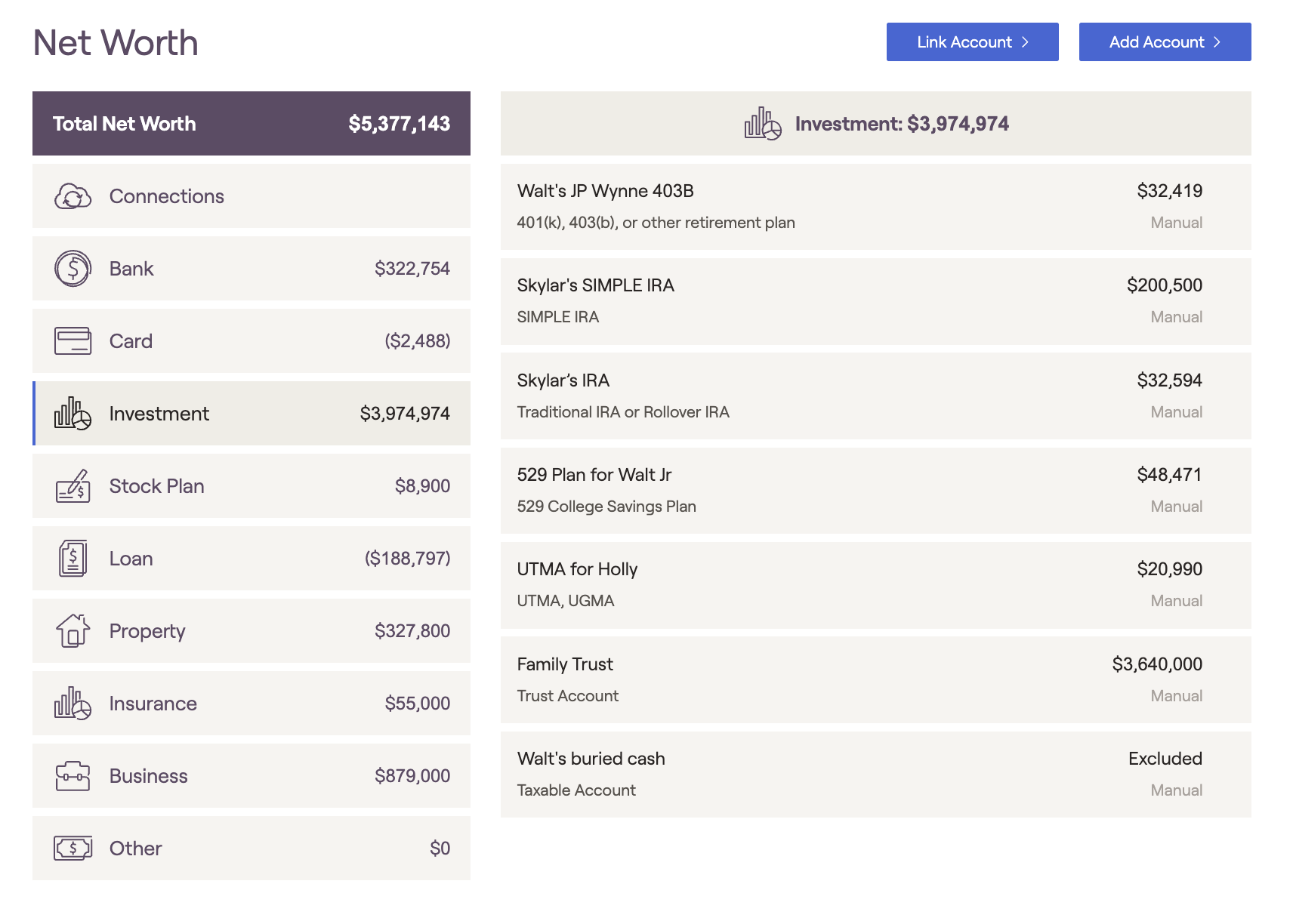
Walter and Skylar complete a concise financial questionnaire, upload documents, and connect their accounts to the planning tools so Daniel can see their complete financial picture.
Step 2 — Identify Opportunities (Month 2)
Daniel reviews, organizes, and analyzes their data, runs the Monte Carlo baseline, and pinpoints the moves most likely to improve their retirement.
Step 3 — Build Your Retirement Strategy (Months 2–3)
Interactive 60–90 minute Zoom sessions turn the analysis into one integrated strategy. Together, they answer: when can they retire, what can they safely spend, and which changes raise the odds of success?
Step 4 — Implement the Plan (Month 3+)
Daniel helps translate decisions into action: account transfers, investment changes, Roth conversions, and coordination with other professionals.
Step 5 — Continue Adapting (Ongoing)
Markets, tax laws, and life change. Daniel monitors the plan and meets with clients 2–3 times per year to keep it on track.
Step 1 in Detail: Understand Where You Stand
Clarifying Goals & Tradeoffs
From structured conversations and a goals worksheet, Daniel captures the “why” behind the numbers:
Education: Fund higher education for Holly (tuition + room & board)
Family & travel: Alaska trip every two years to visit a close friend
Legacy: A high priority—Walter would like to leave ≥$5M to the children
Business transition: Sell the car wash at retirement to simplify cash flow
They agree that legacy is “must-have,” while retirement date and spending can flex if needed.
Gathering Documents
Walter and Skylar upload:
Recent tax returns and W-2/1099s
Statements for 401(k)/403(b)/457/TSP, IRAs, brokerage, bank, HSA
Pension estimates and Social Security statements
Insurance (life, disability, long-term care, annuities)
Estate docs (will, trust, POAs, health directives)
Setting Up Planning Tools
RightCapital for collaborative planning, account aggregation, and Monte Carlo simulations. Linking bank, investment, mortgage, and credit accounts gives Daniel clean, real-time data without email back-and-forth.
Step 2 in Detail: Identify Opportunities
With the discovery work complete, this step turns insight into strategy. Daniel now takes the raw data—their income sources, investments, pensions, and expenses—and transforms it into a clear picture of where they stand and what’s possible. This is where financial planning shifts from numbers to decisions. Over the next several weeks, Daniel reviews, organizes, and analyzes every piece of information, then hosts a series of 60–90 minute Zoom sessions to refine the plan together. These meetings are highly interactive, designed to test real-life scenarios and explore tradeoffs so they can make confident, informed choices. Together, they’ll answer the questions that matter most:
When can they retire?
What can they safely spend?
Which changes raise the odds of success?
Income: Timing, Sources, & Amounts
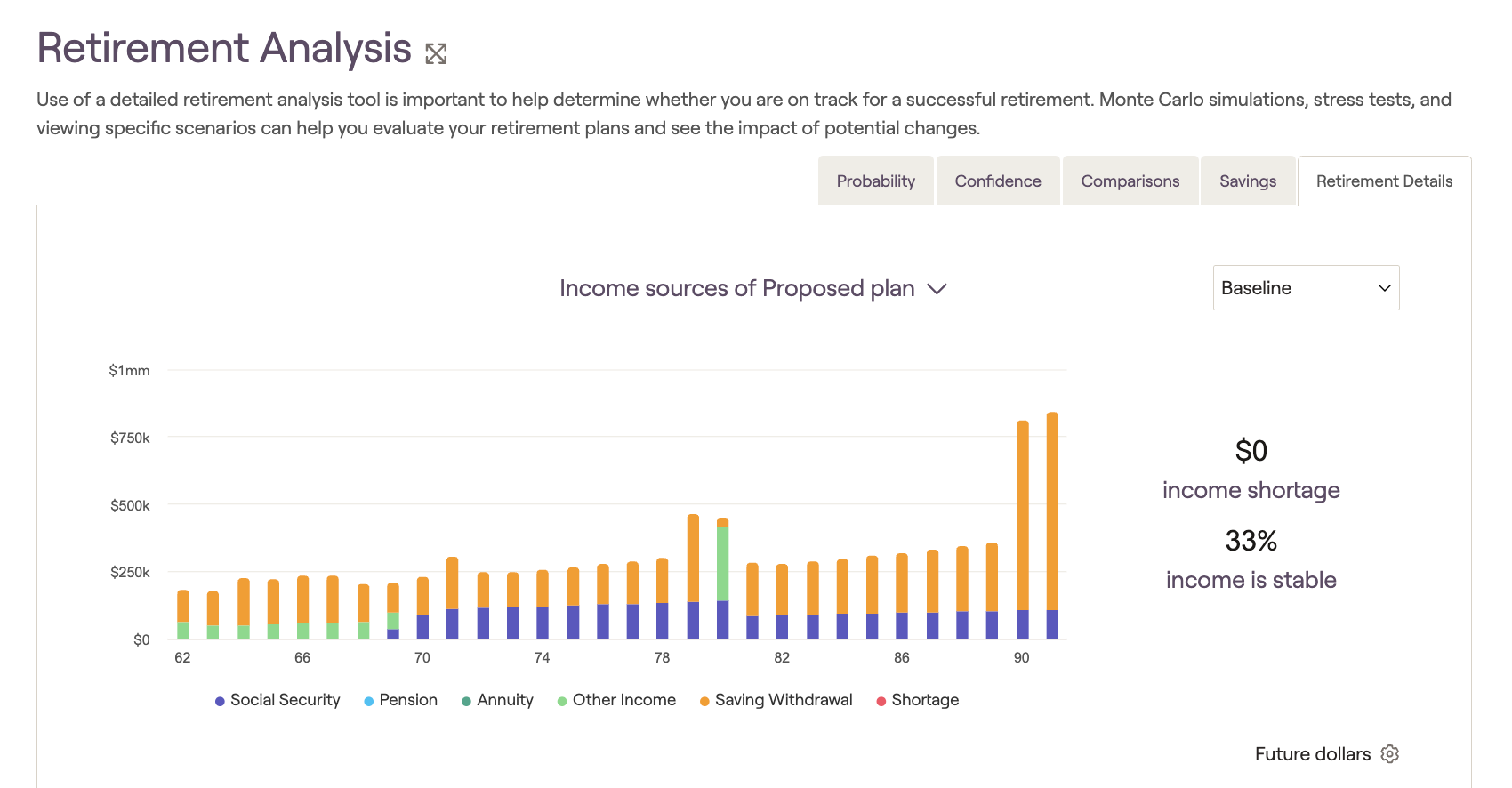
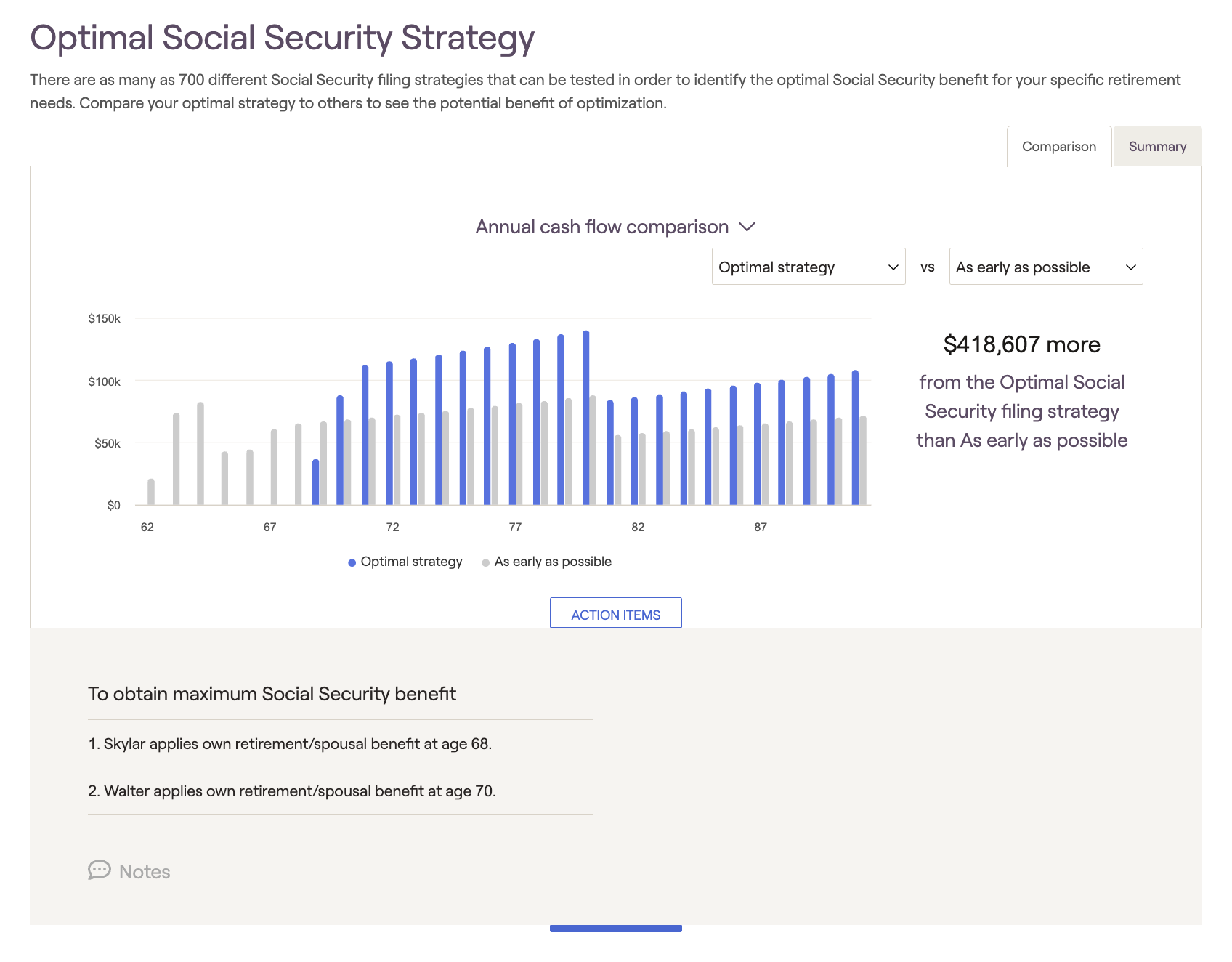
Daniel reviews the source, amount, and timing of all income streams—both before and after retirement—to anticipate tax implications and ensure smooth cash flow throughout the transition. The initial Social Security intent is for Walter to claim at 67 (FRA) and Skylar at 62, but Daniel flags this for review since timing affects lifetime income, survivor benefits, and overall tax efficiency. He explores the couple’s rationale and models alternative claiming strategies to help identify the optimal approach.
Portfolio & Allocation
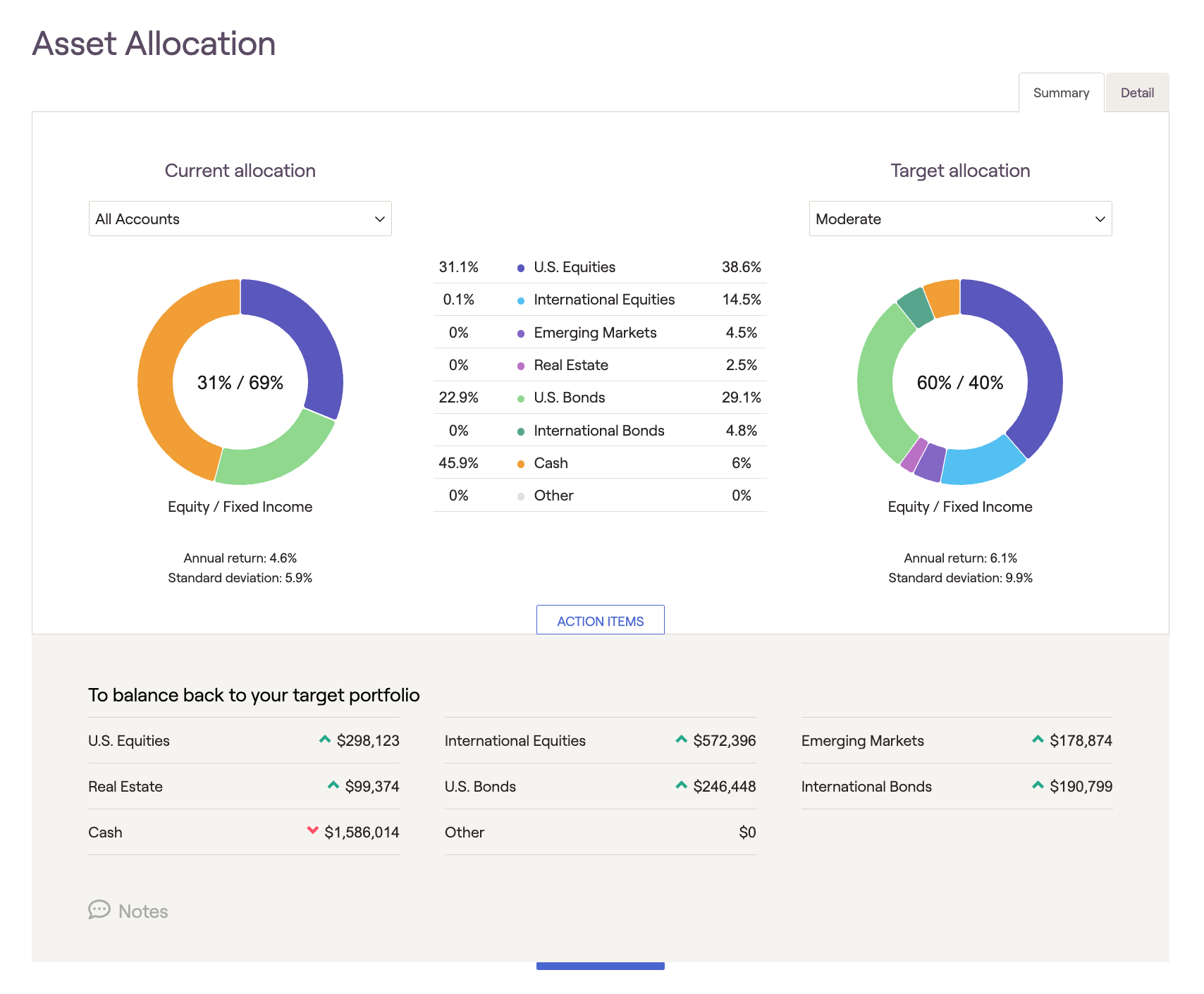
Daniel first evaluates asset allocation (AA)—the primary driver of long-term outcomes. He notes excess cash (under-invested dollars) and asks about risk comfort and the reason for cash buildup.
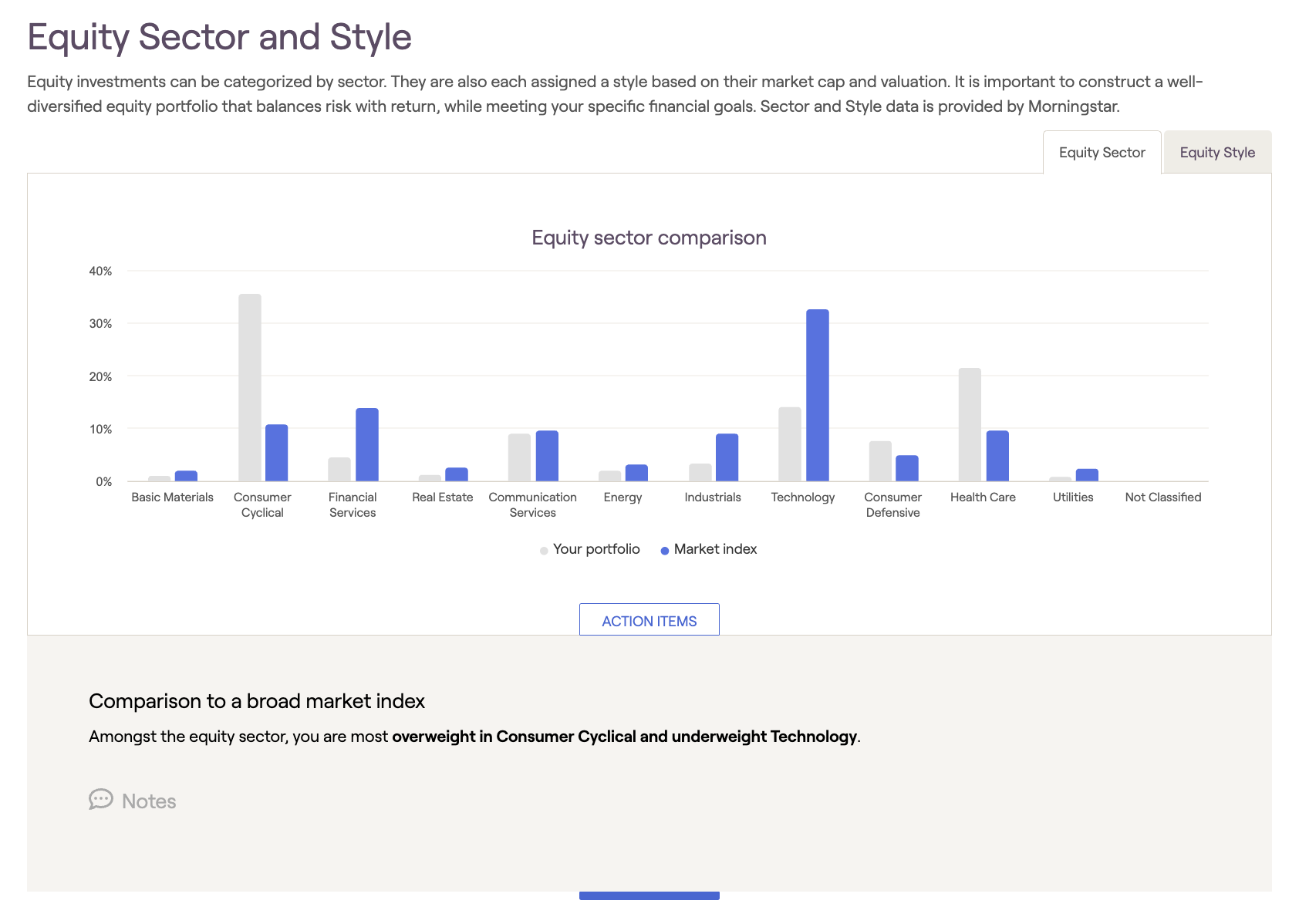
He then reviews style/sector exposures relative to the broad market to check diversification. The current portfolio appears under-weighted to technology and over-weighted to consumer cyclicals versus the market—acceptable only if intentional; otherwise it introduces uncompensated tracking risk.
Retirement Readiness (Monte Carlo)
Daniel aggregates their goals, spending, income, and portfolio into a 1,000-trial Monte Carlo simulation.
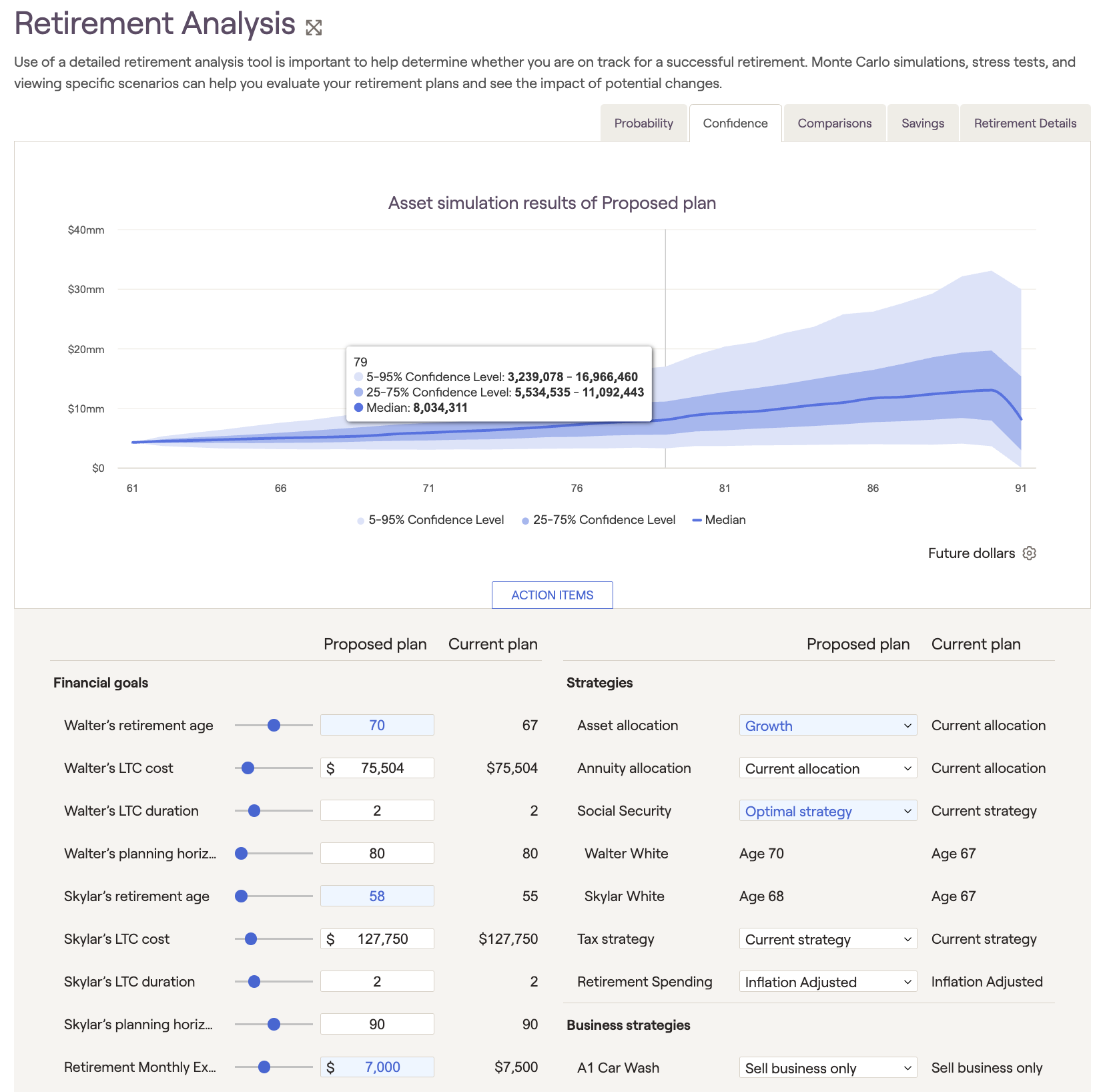
This analysis models how their plan could perform across a wide range of market conditions—both good and bad. The result is displayed as a visual graph that starts as a narrow cone and gradually fans out over time. The widening shape represents uncertainty: in the early years of retirement, outcomes are relatively predictable, but as time passes, investment returns, inflation, and life events cause the range of possible results to spread wider. This visual helps them see not just whether their plan is likely to succeed, but also how sensitive it is to market volatility, spending choices, and timing decisions—turning abstract probabilities into a clear picture of long-term financial resilience.
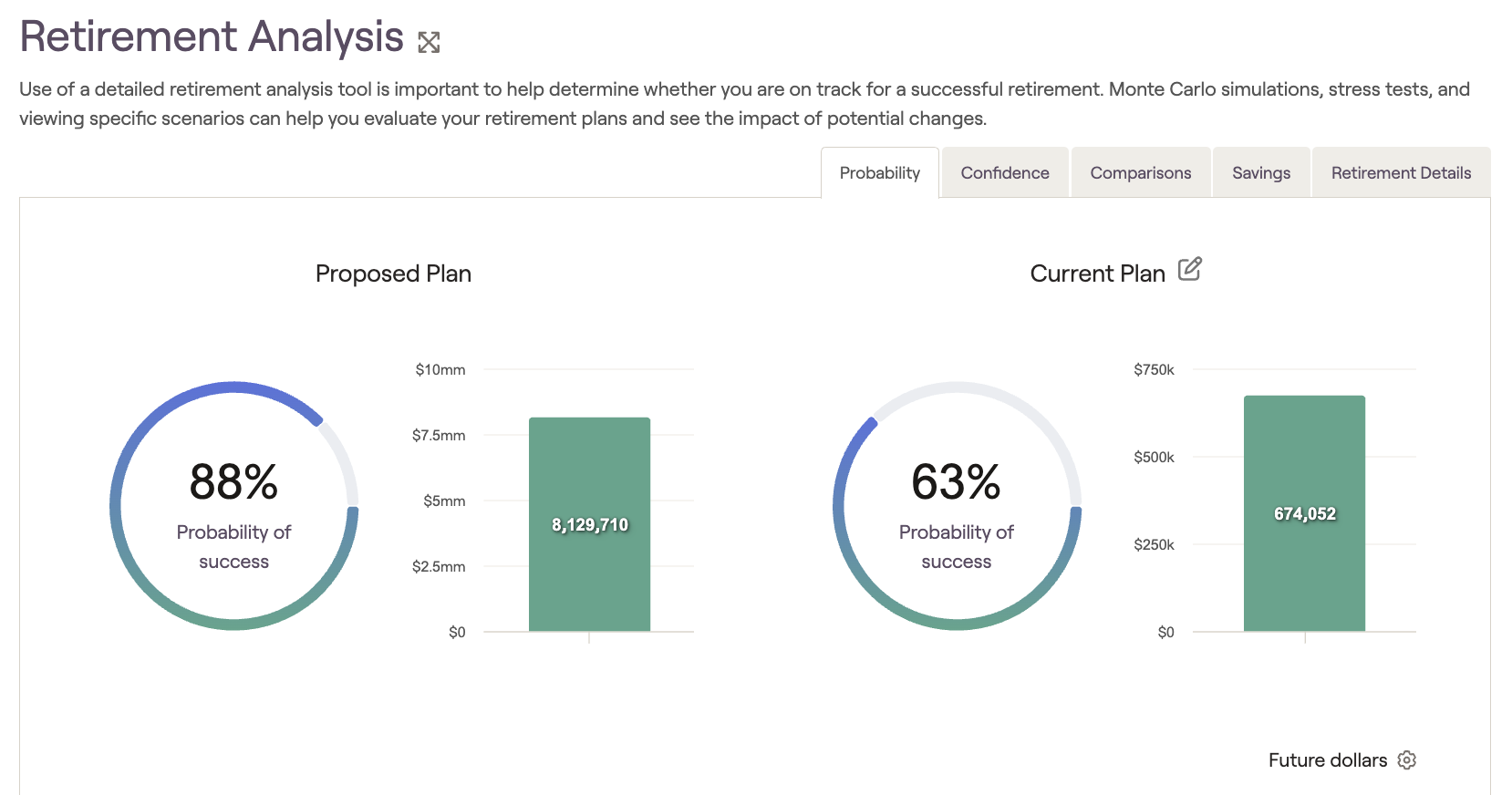
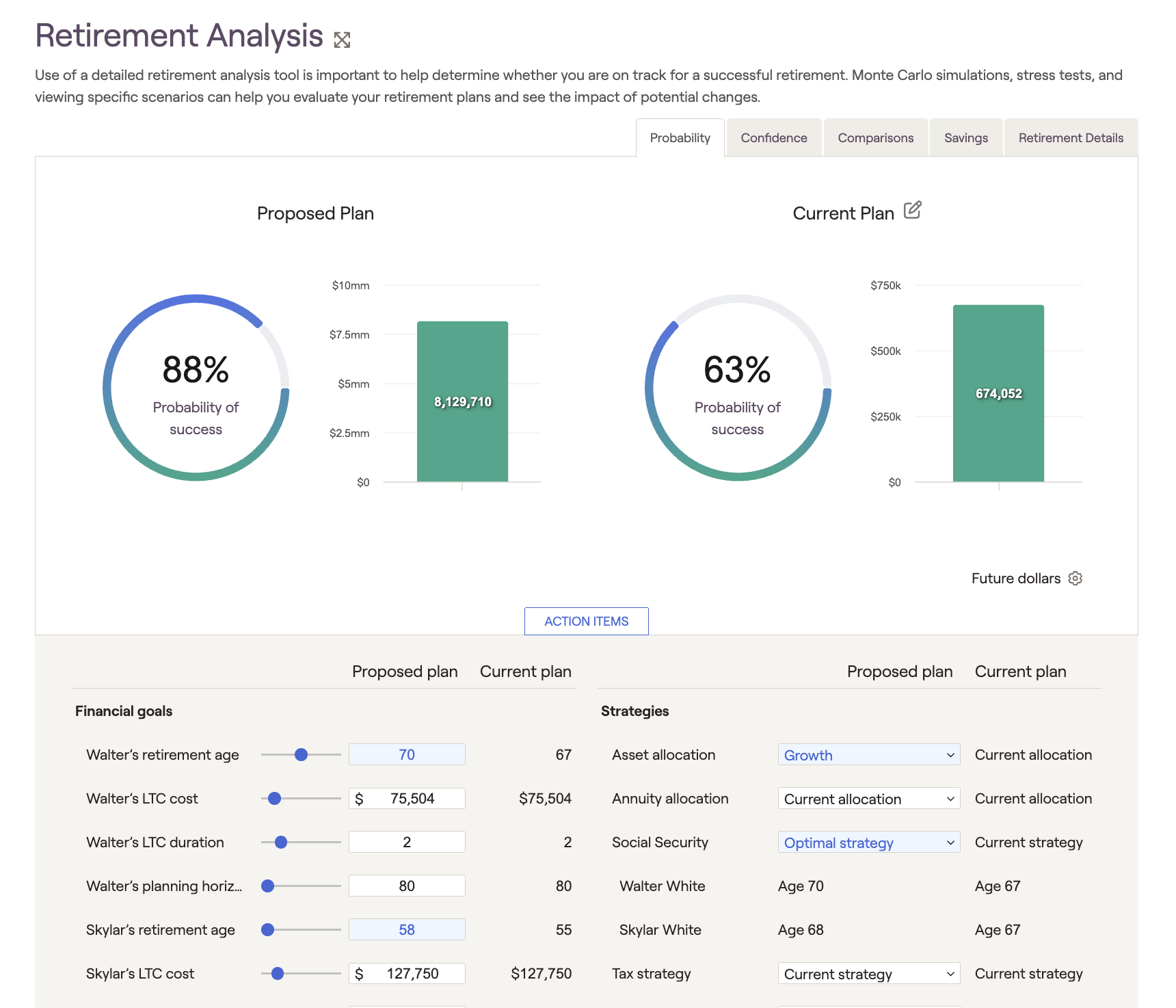
Initial probability of success: ~63% (any score above 80% is considered a strong plan) He uses this as a decision engine, testing levers (spend, work, save, allocation, Social Security timing, Roth conversions) and comparing scenarios side-by-side.
With a few modest changes—and one or two bigger levers—Walter & Skylar’s plan moves from the mid-60s to the high-80s probability of success. Daniel emphasizes the playbook and tradeoffs more than the single output number.
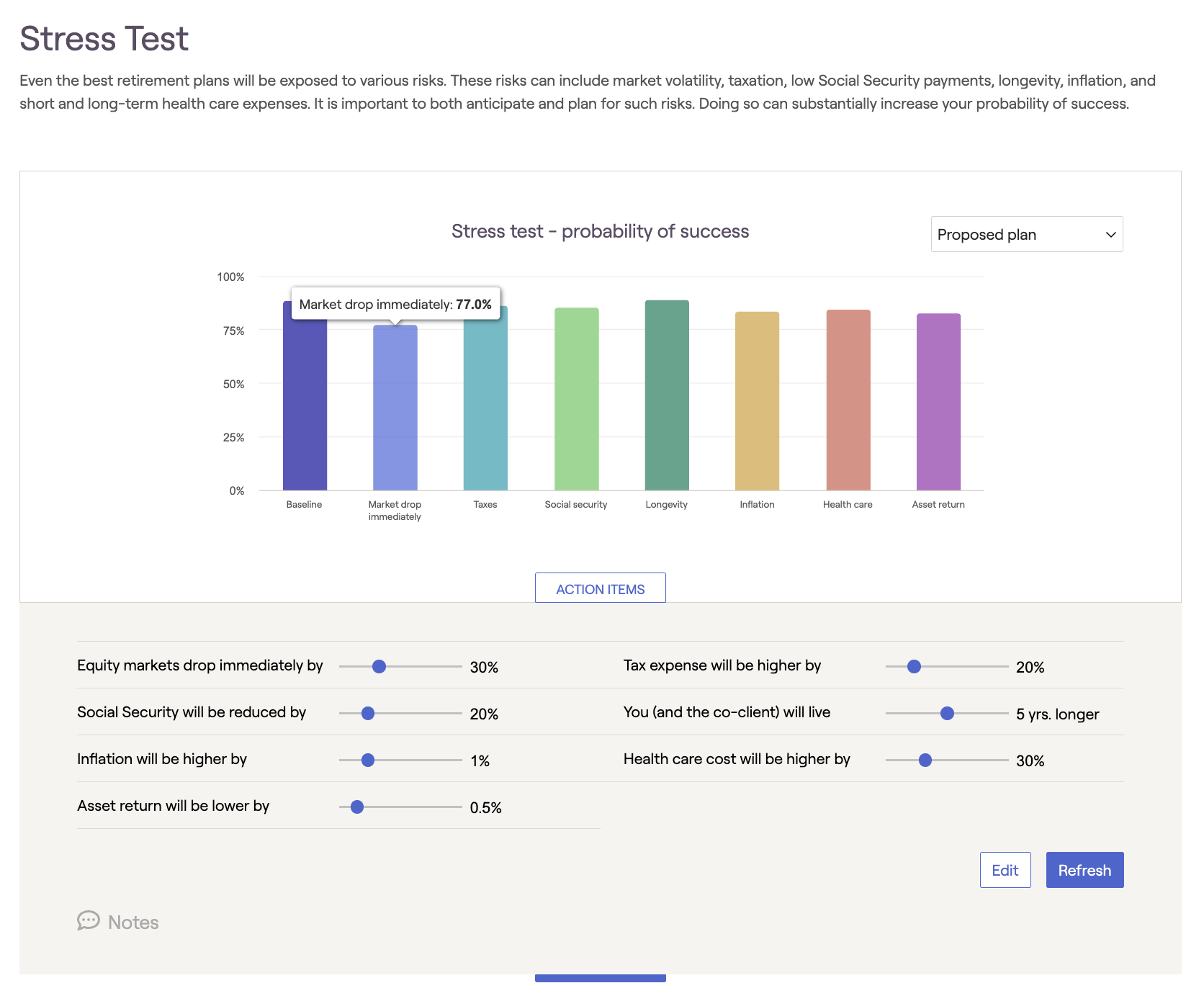
Daniel then stress tests to see how their plan holds up under adverse conditions—such as a major market downturn, higher inflation, or unexpected healthcare costs. By isolating and testing each scenario, he shows how these risks could affect their probability of success and long-term cash flow. This helps Walt and Skylar see which factors have the greatest impact and where adjustments—like reducing spending or shifting investment strategy—could strengthen their plan’s resilience.
Step 3 in Detail: Build Your Retirement Strategy
With their Monte Carlo probability of success at 63%, Daniel identified several levers to improve Walter and Skylar’s plan while staying true to their goals and values. Since their top priority is leaving a $5M legacy, while retirement timing and spending are more flexible, the recommendations focused on optimizing income strategies, reducing idle cash, and considering modest lifestyle adjustments.
1) Optimize Social Security Strategy
Walter initially planned to claim at age 67 and Skylar at 62. Daniel modeled alternative strategies and recommended delaying Skylar’s claim until closer to age 68. This increases lifetime household income, strengthens survivor benefits, and meaningfully raises their retirement success probability without requiring additional savings.
2) Put Idle Cash to Work
A large portion of their portfolio was sitting in cash, which dragged on long-term growth potential. Daniel recommended investing these funds into a diversified, low-cost portfolio of stocks and bonds aligned with their risk tolerance and long-term legacy goals. Modeling showed that even a moderate reallocation improved their probability of success substantially.
3) Flex on Retirement Timing
While Walter and Skylar prefer to retire in about two years, they expressed openness to working longer if it meant greater confidence in funding goals. Daniel showed that delaying retirement by three years would add significant buffer: more years of income, fewer years of withdrawals, and additional growth in the portfolio.
4) Refine Cash Flow and Savings
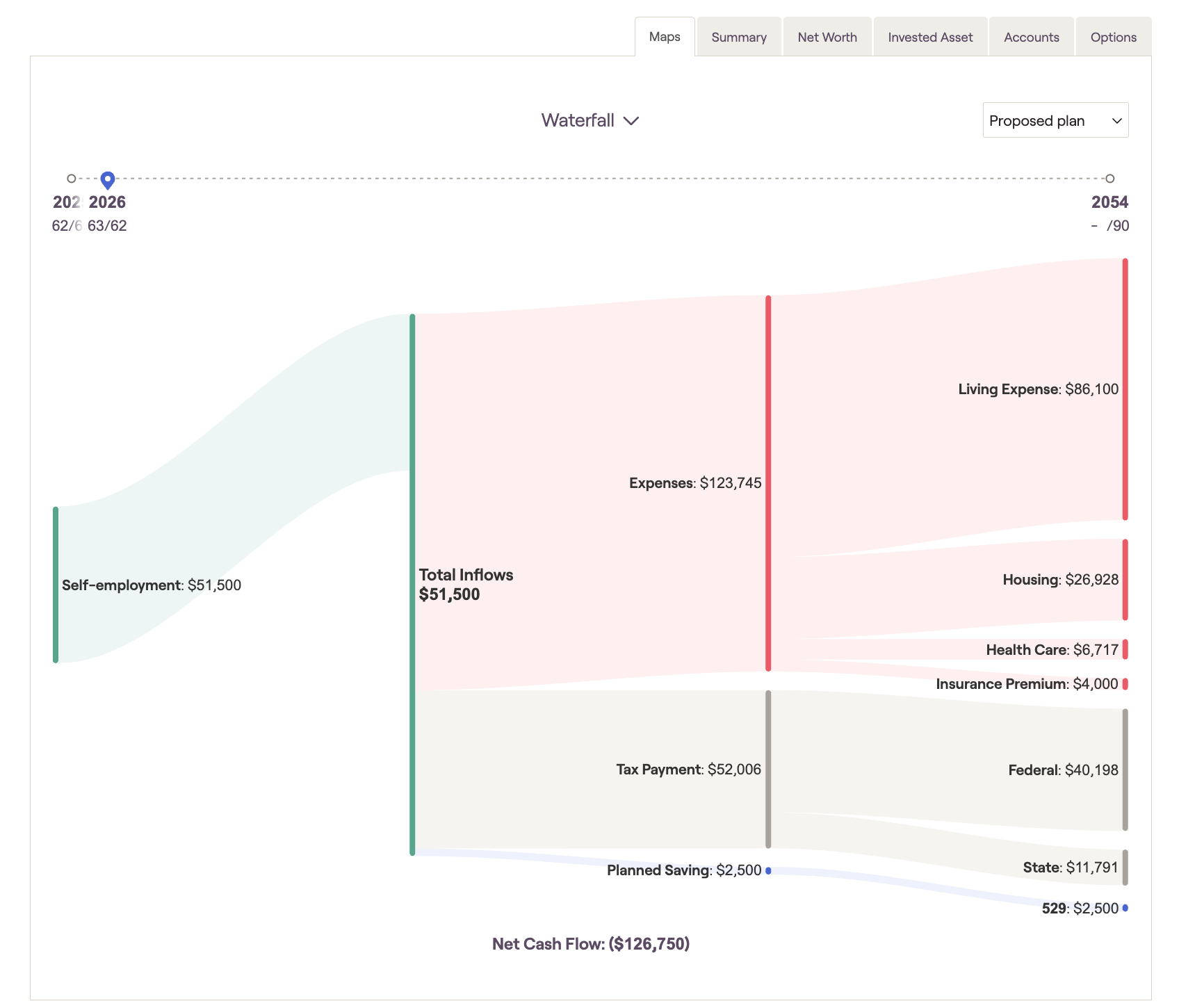
Cash Flow analysis provides Walt and Skylar with a clear, year-by-year view of how money moves through their plan. It shows their income from Social Security, portfolio withdrawals, and other sources alongside their spending, taxes, and savings, revealing each year’s net cash flow—whether they’re building reserves or drawing down assets. This helps them see how their income and expenses shift before and after retirement, ensuring they stay on track for long-term stability.
This is where Phase 1, The 90-Day Retirement Roadmap, concludes: a stress-tested strategy and a prioritized playbook. Phase 2 is where the plan gets carried out. Walter and Skylar began there directly, so Daniel carries the plan into action.
Step 4 in Detail: Implement the Plan
Great financial plans don’t create results. Implementation does. Clients receive concise status updates so they always know what’s finished and what’s next.
Daniel turns decisions into done:
Project plan & deadlines with three short implementation check-ins
Open and transfer accounts to Charles Schwab and automate contributions
Set rebalancing and tax-loss harvesting rules; update beneficiaries; coordinate with the CPA
Execute Roth conversions and other tactics in the right years/amounts
For Walter and Skylar, implementation isn’t a checklist that ends. It’s the start of an operating system. Everything from here forward is organized around four coordinated pillars.
The Four-Pillar Retirement Strategy
Most retirement advice stops at recommendations. Phase 2 is built around a simple promise: we connect income, investments, taxes, and estate planning into one retirement strategy — so your paycheck, portfolio, tax decisions, and legacy plan work together as life changes.
Each pillar produces its own plain-language deliverable, dated and updated on a schedule — and whenever life changes. Here’s what each one looks like for Walter and Skylar.
Pillar 1: Income — The Retirement Paycheck Plan
The first question every retiree asks is the most practical one: where will my monthly income come from when the paycheck stops?
Daniel converts the approved strategy into a Retirement Paycheck Plan that answers exactly that: how much will arrive, when it will arrive, which accounts will fund it, and what taxes will be withheld — so the household never has to improvise a withdrawal.
For Walter and Skylar, that means:
A monthly “retirement paycheck” deposited to their bank account, sized to their ~$7,500/month spending target
A year-by-year schedule showing stable income (Social Security, eventually both benefits) flowing in first — with the portfolio filling only the remaining gap
An account withdrawal sequence (which accounts to draw from, in which years, and why) coordinated with the tax plan
Tax withholding and estimated-payment instructions handled as part of each distribution
A clear picture of how the paycheck changes when Skylar’s delayed Social Security begins and when required minimum distributions start
The plan is reviewed every year — and re-run any time spending, health, or income sources change.
Pillar 2: Investments — The Retirement Resilience Plan
A portfolio isn’t just an allocation — in retirement, it has three distinct jobs: fund the paycheck, absorb surprises, and keep growing for the decades ahead. The Retirement Resilience Plan assigns every dollar to one of those jobs so nothing is double-counted and no market decline forces an improvised decision.
The Market Protection Reserve. Instead of asking only “how do you feel about risk?”, Daniel asks a retirement-specific question: if stocks fell sharply right after you retired, how many years of withdrawals would you want covered by cash and predictable maturities before you’d need to sell stocks? Walter and Skylar settle on five protected years — funded with cash, Treasuries, and CDs that mature before each year’s spending is needed.
The Retirement Flexibility Reserve. A separately labeled reserve for the irregular expenses every retirement actually contains — a roof, a car, the Alaska trip every two years, family gifts — so surprises don’t disrupt the monthly paycheck or force an unplanned sale.
The Down-Market Action Plan. Written in advance, in calm markets: what gets communicated, reviewed, and considered at roughly -10%, -15%, and -20% — rebalancing within approved bands, tax-loss harvesting, and whether a decline opens a Roth conversion opportunity. When markets fall, Walter and Skylar aren’t deciding what to do. They’re executing a plan they already approved.
Because near-term spending is protected, the long-term growth portfolio — the engine behind their $5M legacy goal — can stay invested through downturns.
Pillar 3: Taxes — The Lifetime Tax Map
Most tax work optimizes one year at a time. The Lifetime Tax Map coordinates decisions across Walter and Skylar’s lifetime — because the cheapest year to pay a tax is rarely this one.
Their map highlights a multi-year, low-income window between retirement and the start of Social Security and RMDs. Each year, Daniel updates the plan and coordinates with their CPA on:
A staged Roth conversion target (a range, not false precision) sized to fill lower brackets during the window
Withdrawal sequencing that keeps taxable income inside the intended corridor
Medicare IRMAA and other threshold watch-points, so a smart-looking conversion doesn’t trigger an expensive surcharge
Capital-gain and tax-loss harvesting opportunities — especially during market declines
Qualified Charitable Distributions once RMDs begin, aligned with their giving
A year-end execution checklist with deadlines, so approved strategies actually happen
The goal isn’t to minimize this year’s tax bill. It’s to reduce the total taxes the household — and eventually their children — pay over decades.
Pillar 4: Estate — The Estate & Legacy Plan
Walter’s top priority is leaving at least $5M to Walter Jr. and Holly. A number that important shouldn’t rest on documents nobody has reviewed since they were signed.
Each year, Daniel maintains an Estate & Legacy Plan that:
Inventories the core documents — will, trust, powers of attorney, healthcare directives — with execution and last-review dates
Checks that account titling, trust funding, and every beneficiary designation actually match the couple’s intentions
Confirms the surviving spouse could locate key information and act quickly after a death or incapacity
Flags gaps, stale documents, and conflicts — then coordinates the legal work with their estate attorney (Daniel doesn’t draft legal documents or provide legal advice)
Implements the advisor- and custodian-level fixes — beneficiary updates, account retitling — and verifies completion
How the Pillars Work Together
The four pillars aren’t four separate services — each one feeds the others:
The Paycheck Plan defines the withdrawals the Resilience Plan must protect
The Tax Map decides which accounts fund the paycheck — and when a down market becomes a conversion opportunity
The Estate Plan shapes account ownership, beneficiaries, and how the legacy goal is invested
A market decline triggers responses in all four: protected assets fund spending, the action plan governs rebalancing, the tax map screens for opportunities, and survivor liquidity is re-checked
That’s the difference between owning four plans and having one strategy.
Step 5 in Detail: Continue Adapting
Markets, tax laws, health, family, and priorities all change. Step 5 keeps the four pillars current instead of letting the plan age on a shelf.
The ongoing rhythm for Walter and Skylar:
2–3 scheduled meetings per year, each anchored to a pillar review — the paycheck and cash schedule, the investment and resilience review, and the fall tax-planning review timed so Roth conversions and harvesting can be executed before year-end
An annual estate alignment check, plus reviews triggered by life events — a family change, an inheritance, a property sale, new tax law
Down-market activation: when a decline crosses a planned threshold, the Action Plan runs — communication first, then the approved portfolio and tax steps
Dated updates after every review showing what was checked, what changed, what was deliberately left alone, and when the next review happens
Ad-hoc access when life happens — an advisor who already knows the whole picture, before big decisions get made
In Summary
This plan gives Walter and Skylar clarity about what’s possible, a simple playbook for what to do next, and a partner to keep it on track. Phase 1 organized every moving part — income, investments, Social Security, taxes, and spending — into one picture, tested it against good and bad markets, and showed which changes make the biggest difference. Phase 2 turned that picture into an operating system: a monthly retirement paycheck, a resilient portfolio with a written down-market plan, a lifetime tax map, and an estate plan that’s checked — not assumed. Four pillars, one strategy, reviewed on a schedule and adapted as life changes. The result is less noise, more confidence, and a calmer path to the retirement they want.
Frequently Asked Questions
How long does the process take? Steps 1 through 3 typically take about 90 days, depending on complexity and scheduling. Steps 4 and 5 — the Four-Pillar Retirement Strategy — continue as long as the ongoing relationship does.
What does it cost? Daniel is fee-only. Phase 1, The 90-Day Retirement Roadmap, is a one-time planning fee. Phase 2, Implementation & Ongoing Wealth Management, is an ongoing relationship with an asset-based fee, subject to a minimum annual fee, and the planning fee can be waived when you begin there. Exact fees are quoted up front and listed on the pricing page.
What do I actually receive in the ongoing relationship? Four coordinated, plain-language deliverables — a Retirement Paycheck Plan, a Retirement Resilience Plan, a Lifetime Tax Map, and an Estate & Legacy Plan — each dated, reviewed on a schedule, and updated when life changes. Plus the implementation, monitoring, and access described in Steps 4 and 5.
Will a retirement plan actually help? Yes. A good plan improves financial literacy, aligns money with values, and provides an adaptable playbook for both expected and unexpected events.
Masuda Lehrman Wealth LLC is an investment adviser registered with the State of Hawaii. Registration does not imply a certain level of skill or training. Although we provide our services virtually to individuals throughout the United States, we may provide individualized investment advice or recommendations to clients only in jurisdictions where we are properly registered, notice-filed, or exempt from registration. We will verify that we are authorized in the appropriate jurisdictions before providing services to new clients.